

Larry Lyon
Vice Provost & Dean of the Graduate School

Looking back, even as far as 50 years, can still render views that are more accurate than looking forward. Management guru Peter Drucker once observed that "Trying to predict the future is like trying to drive down a country road at night with no lights while looking out the back window." My predictions have often missed the mark during my time at Baylor, including how long it would take for us become R1, as referenced in my “Looking Back” column. Still, there is an old prediction I got right that makes me quite confident in now predicting the Graduate School’s future.
Twenty years ago, a chapter I wrote for a controversial book entitled The Baylor Project (edited by Barry Hankins and Don Schmeltekopf), predicted that if Baylor:
- “emphasized the mutually reinforcing links between graduate and undergraduate education, and between teaching and research,”
- “accepted increasing tuition levels and built a larger endowment,” and
- “adopted a broad tent to include and value faculty with disparate views on how their faith might affect their teaching and research,”
“the result could be a new, shared narrative that reunites the Baylor community and challenges us to build a unique university—a university that combines undergraduate education, graduate education, financial support, and faithful faculty in a way that is without precedent in modern higher education.” We did the three hard things bulleted above, and we are now the unprecedented new thing: a Protestant research university.
It’s easy to say now that we successfully did it, but when I wrote the three recommendations listed above, all were highly contested. When I made that prediction, it was a time of debilitating internal conflict. All copies of the original book that published the recommendations and the prediction were literally destroyed by the University during the Vision 2012 “civil war.” At the time, the prediction reflected my hope as much as my belief. But my hopeful prediction proved true. When Baylor linked graduate and undergraduate education, strengthened our financial base, and reduced the divisiveness of our religious differences, we progressed with unprecedented speed toward becoming a major Christian research university.
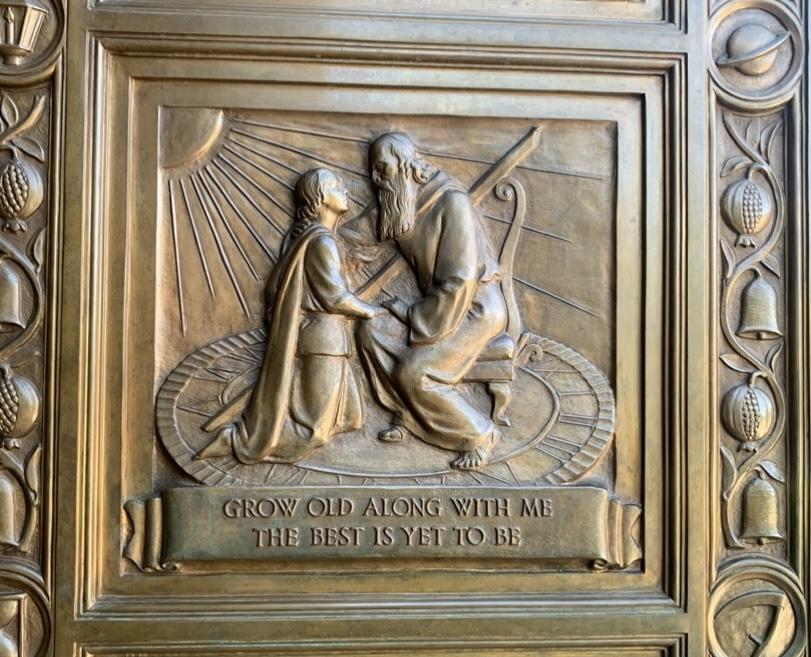
The reunited Baylor of today gives me much more confidence in the future than I possessed two decades earlier. We now broadly share a goal of becoming, in the words of President Livingstone, “the premier Christian research university.” This broadly accepted understanding of Baylor ensures a Graduate School of growing significance to the University. Challenges remain, but I have never been more optimistic about graduate education at Baylor. Our graduate students and faculty and our Graduate School personnel have never been stronger than they are today. Looking forward, there is little reason to not expect that Baylor’s graduate enrollment, the excellence of our graduate students, our doctoral production, the quality of our graduate placements, the research productivity of our graduate faculty, and the reputation of graduate education at Baylor will continue to grow. In the words of Baylor’s favorite poet, Robert Browning, “The best is yet to be.” The quote certainly applies to our Graduate School, and the extended quotation below applies to a dean approaching retirement.
“Grow old along with me!
The best is yet to be,
the last of life,
for which the first was made.
Our times are in his hand who saith, ‘A whole I planned,
youth shows but half;
Trust God: See all, nor be afraid!”— Robert Browning (1812-1889)
< Looking Back Next: Graduate School Enrollment and Graduation >