

Larry Lyon
Vice Provost & Dean of the Graduate School
Looking back, for me, is looking way back. I was hired as an assistant professor in Baylor’s Sociology Department in 1975. I became Baylor’s Graduate Dean in 1998. By the time of my upcoming retirement in May of 2025, I will have been privileged to serve 50 years at Baylor, with 27 as Dean of the Graduate School.
The differences between then and now are striking and easily visible. Today, we are excited about the new Foster Pavilion replacing Ferrell for basketball. In 1975, the Ferrell Center was still a decade away, with basketball (and commencement) in the Heart of Texas Coliseum. The then new Moody Library sat on the edge of campus and housed my first faculty office. Sociology did not move to Georgia Burleson Hall, originally a women’s dormitory, until the early 1980s, with an extensive remodeling of all the Quadrangle buildings to make them look like they did 100 years earlier. We became the nation’s only sociology department located in a building dedicated to female piety.

The campus still had not changed that much when I became Graduate Dean in 1998, moving into a wing of the Jones Library, built adjacent to Moody Library. In 2002, the Graduate School moved into its current location, Morrison Hall, formerly the home of the Law School. The Graduate School changed locations, but its scope and resources remained largely the same.
Not only did the campus not change physically, but during my early years, academically, the status quo prevailed. For example, in the early 80s, President Reynolds suggested AAU membership as a worthy goal for Baylor, a goal that would necessitate great expansions in graduate education. However, the faculty were not sympathetic. The faculty who produced Baylor’s 1984-85 Self-Study concluded that:
"In terms of its student body, the allocation of its resources, and the commitment and interest of its faculty, Baylor University has been and continues to be primarily an undergraduate education institution. The steering Committee of the Institutional Self-Study recommends no change in this priority."
A decade later, I hoped for a different result when I directed our Self-Study in 1995 and recommended that Baylor raise tuition to fund stronger academics, including graduate education. However, that recommendation was amended by the new administration, replacing higher tuition with a call for “world class” fund raising.
In short, Baylor changed relatively little during my first two decades here.
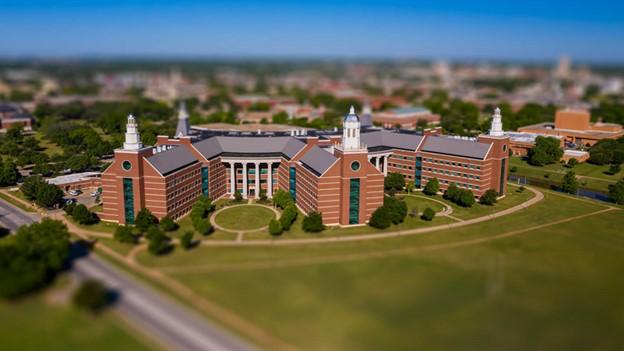
Significant remaking of our campus did not begin until the opening of the massive Baylor Science Building in 2004. That building is still one of the most impressive and important structures on Baylor’s campus, leading the way for growth toward and even beyond the Brazos. The Science Building physically represented a deep and contentious cultural shift at Baylor, away from a regional teaching university toward a national research university. It was our first campus building financed through bonded indebtedness - a highly controversial decision at the time - and the first to include significant space for laboratories and graduate students. Looking back, the Baylor Science Building and the even more contested plan that produced it, Vision 2012, are among the most noteworthy events of my very long time at Baylor.
Although Baylor didn’t change that much physically, academically, or culturally early in my career, the pace of change sped up in the 2000s with the adoption of Vision 2012. Baylor became a much different place. It is almost impossible to overestimate the magnitude of those changes. The Graduate School was able to play a role in those changes; I was privileged to play a role in the Graduate School.
That’s enough of relying completely on personal recollections. I am more comfortable focusing largely on numbers and graphs to allow a less subjective look back at my fifty years at Baylor. These more objective snapshots of Baylor and the Graduate School look at four significant times for my career:
1) joining the University in 1975
2) becoming Graduate Dean 23 years later in 1998
3) followed by the midpoint of my tenure as dean, 2011, and
4) ending with my penultimate year in the Graduate School and the year described in this Annual Report, 2024.
1975
“I didn’t know Baylor has a Graduate School."
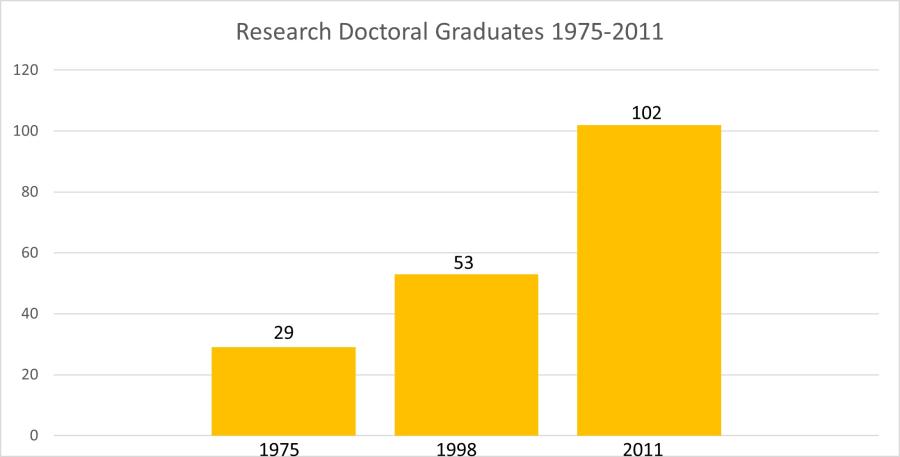
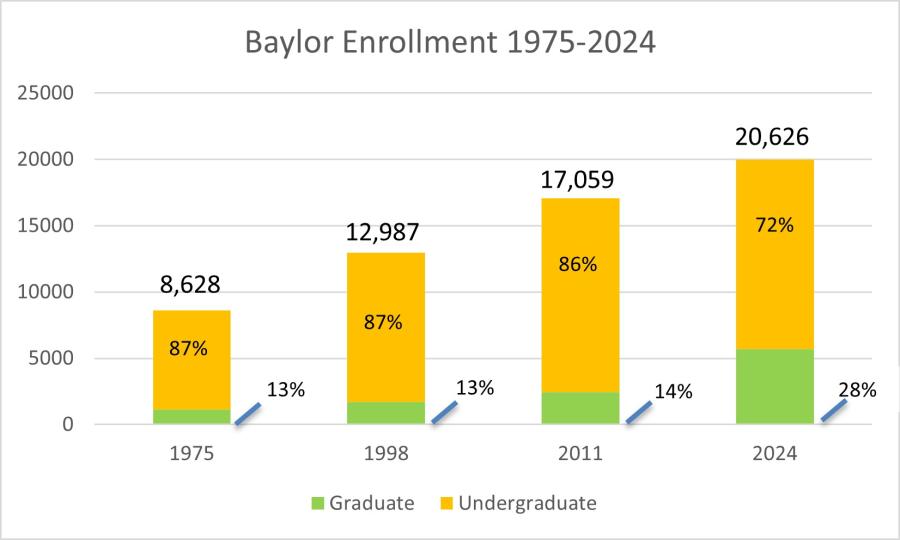
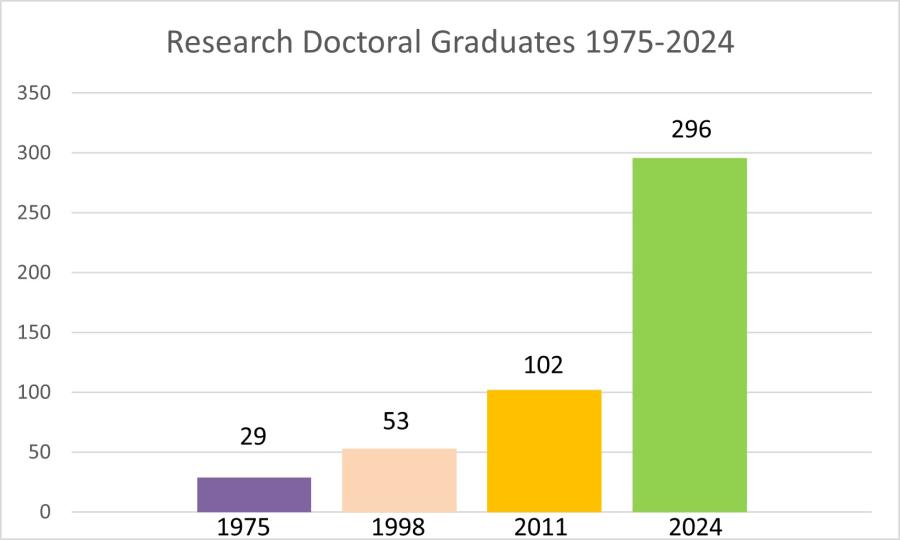
Baylor, in 1975, enrolled a then record number of 8,628 students, but only 13% (1,134) were graduate students, and over a third of the graduate students (35%) were in the Law School. While law students are graduate students, the Law School was and remains administratively separate from the Graduate School. And a note that will become important for R1 status later, we graduated only 29 research doctoral students in 1975.

As a new assistant professor in Sociology, I was quite unaware of these numbers or of the Baylor Graduate School. I was, in fact, aware of very little outside my department in Moody Library. This was hardly unusual; I suspect that many of our faculty and certainly most of our students didn’t even know Baylor had a Graduate School. Baylor was a regional Baptist undergraduate institution in 1975, and most of us didn’t consider what that meant in relation to the growing number and influence of national research universities with their large graduate programs. Rather than thinking about broader academic issues, I kept busy teaching multiple sections of intro sociology each year while my wife, Carol, tried to find a house that we could afford on my $10,000 annual salary.
1998
“Does Baylor even need a Graduate School?”
Twenty-three years later, when I became Dean, there were lots of changes in the Lyon family. Carol found a home we could afford, and my daughters, Laura and Lisa, had both graduated from Baylor. For graduate education at Baylor, however, very little had changed.
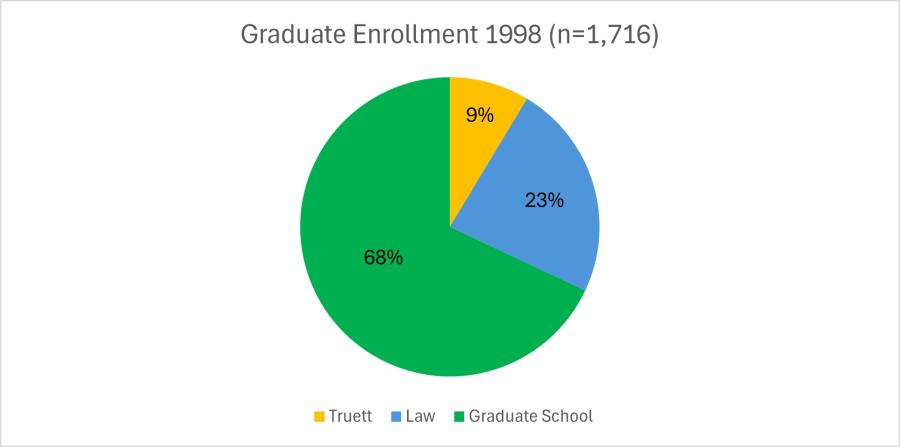
Baylor’s total enrollment had grown to 12,987, with 1,716 graduate students still accounting for 13% of Baylor’s total enrollment, just as in 1975. Law enrollment was holding steady, so its proportion declined from 35% of the total graduate enrollment to 23%. One new professional school had been created in response to Baptist political battles; Truett enrolled 148 seminarians, or about 9% of the total graduate enrollment. Our count of research doctoral graduates grew to 53. Baylor was certainly larger than 1975, but relatively, structurally, it was still the same university.

Graduate education, especially outside of the professional schools, remained small and not especially important to the University. As a telling example, before my appointment as dean, my predecessor was fired, and the President commissioned a faculty committee to investigate the possibility of completely doing away with the Graduate School. Fortunately, for me and for Baylor, the committee recommended that Baylor should keep its Graduate School.
The effects of a long-time neglect of graduate education were becoming clear by 1998. A widely publicized study by the National Science Foundation’s National Research Council ranked research doctoral programs. Only five of our PhD programs were large enough to be ranked, and all five ranked among the bottom 20% nationally. I reported to the Lariat that the Graduate School was working on a “strategic plan” to improve our rankings, but that statement reflected more of a hope than an expectation. Although President Sloan had replaced President Reynolds by this time, there was little indication of how much things would begin to change for graduate education until Sloan presented his controversial 10-year Vision 2012 in 2002.
2011
“The controversies are behind us now, right?”
The 21st century had not begun well for Baylor. Following the release of Vision 2012 in 2002, we suffered through years of tumultuous internecine warfare (divisive alumni revolts, a no-confidence vote from the faculty, multiple presidents and provosts). Personally, I had completed directing my second Self-Study in 2005, with the Faculty Senate choosing to write a competing university-wide Self-Study arguing to our accreditation association that Baylor did not deserve to be reaccredited. As evidenced by Baylor still being in existence, the Southern Association of Colleges and Schools chose to reaccredit us, but Baylor’s divisions remained deep.
2011 appeared to be the beginning of what we all hoped would be a more peaceful time at Baylor under President Starr. That hope was short-lived since the Sexual Assault/Title IX storm was only a year or so away. In any case, because of the bitter Vision 2012 battles, the years between 1998 and 2011 were a bad time for Baylor, but because of Vision 2012's emphasis on graduate education, they were good for the Graduate School.
In the 13 years since 1998, Baylor’s total enrollment had grown to reach 17,059. Graduate enrollment kept pace, at 14% of Baylor’s total student enrollment. By other metrics, however, the Graduate School had done much more than keep pace. Our annual count of research doctoral graduates almost doubled, growing to 102.

A firm called Academic Analytics continued the earlier NRC rankings of doctoral programs and by 2011, we had seven PhD programs ranked among the top half in the nation. This was a remarkable turnaround. Our doctoral programs were finally getting larger and stronger.
Most Baylor folks didn’t notice these changes between 1998 and 2011, and given the resistance among our constituencies to Vision 2012’s emphasis on research and graduate education, that was probably a good thing. To avoid reigniting that conflict, Baylor made few references to Vision 2012, including largely ignoring the significance of the 2012 date the following year, when the plan finally came to a close. However, by 2011, the Vision 2012 strategy regarding the faculty hires and research infrastructure necessary for quality graduate education had been followed in spite of the controversy and that plan was now bearing fruit. Even if it wasn’t widely recognized, Baylor and the Graduate School were getting better, and the best was yet to come.
2024
“We’re R1! Now what?”
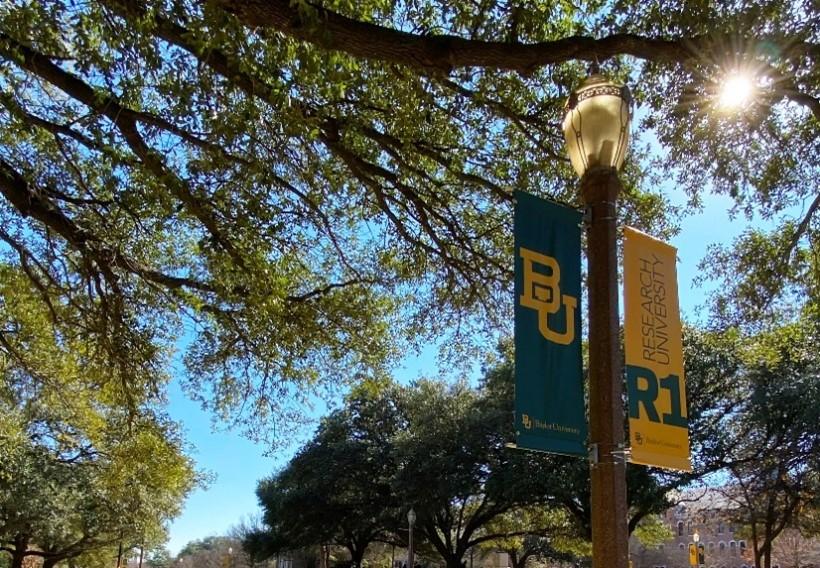
2024 saw Baylor entering its third year as an R1 Research University. I had previously worked with a team trying to project when we would achieve this level of research. We reported to Provost Brickhouse and President Livingstone that Baylor was likely to reach the President’s R1 goal in 2025. Instead, we achieved R1 status in 2022. I was never more pleased to have my prediction proven wrong.
The growth in graduate education during these last 13 years has been unprecedented. While Baylor’s overall enrollment topped 20,000 at 20,626, graduate enrollment grew to 5,711, now accounting for an amazing 28% of Baylor’s enrollment. Much of the increase in graduate enrollment comes from our hybrid professional programs. In 2011, there were no online students. Now, there are over 2,700.
Our research doctoral graduation count almost tripled to approach 300 graduates per year. As a point of perspective, this is more than four times the new baseline (70 research doctoral grads per year) for an R1 university. We now have 18 PhD programs among the top half in the nation of all doctoral programs ranked by Academic Analytics. When I came to Baylor in 1975 and even when I became Dean in 1998, metrics such as these were inconceivable.

Our Graduate School is beginning to look like a research university. And that is our new challenge: Baylor needs to do what is normative for research universities without losing our commitment to the Christian faith. It’s challenging because there are so few models of how to build such a university. Still, there were also few models on how to achieve R1 status as a Christian university, and that did not deter us.
So, to bring this backwards examination of me and the Graduate School to a close:
- 1975 was a time when Baylor had little interest in graduate education and had a new assistant professor in Sociology with very little knowledge of our Graduate School.
- 1998 saw a sociologist become a Graduate Dean who began to discover how far behind Baylor was in comparison to research universities with strong graduate programs.
- 2011 showed that even after all the controversy, Vision 2012 led to major advances in faculty scholarship and graduate education.
- By 2024, Baylor had emerged as a remarkably self-confident research university, embracing the shared understanding that we are a preeminent Christian research university.
Now approaching 50 years at Baylor, the progress I’ve witnessed is unprecedented, and perhaps, given our relatively late start, the intensity of our conflicts, and the audaciousness of our goals, even providential. As for the next 50 years, that’s my Looking Forward column.