

Chris Rios
Associate Dean for Enrollment Management
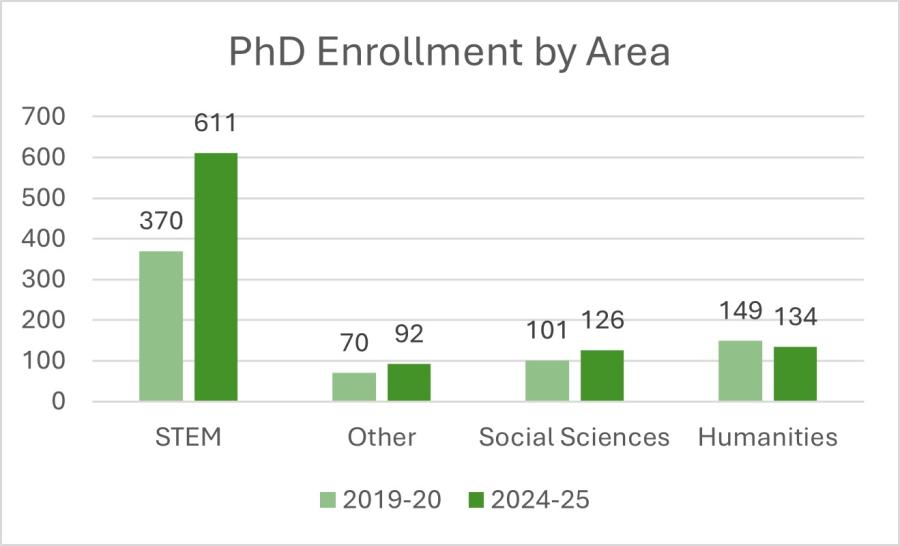
2024 marked the culmination of a strategic PhD enrollment plan developed in 2019. The goal was to add 200 new funded doctoral student lines over a five-year period in areas where more students could be successfully mentored and more graduates would find a healthy job market. In 2020, with the support of Provost Brickhouse and cooperation from Graduate Program Directors across campus, the plan launched. How did we do? Our projections called for a 30% increase in total enrollment. We grew by 40%. Our most aggressive goals were in the fields of biology and chemistry. Both areas exceeded expectations. And of course, in the fall of 2021 Baylor was recognized as an R1 university.
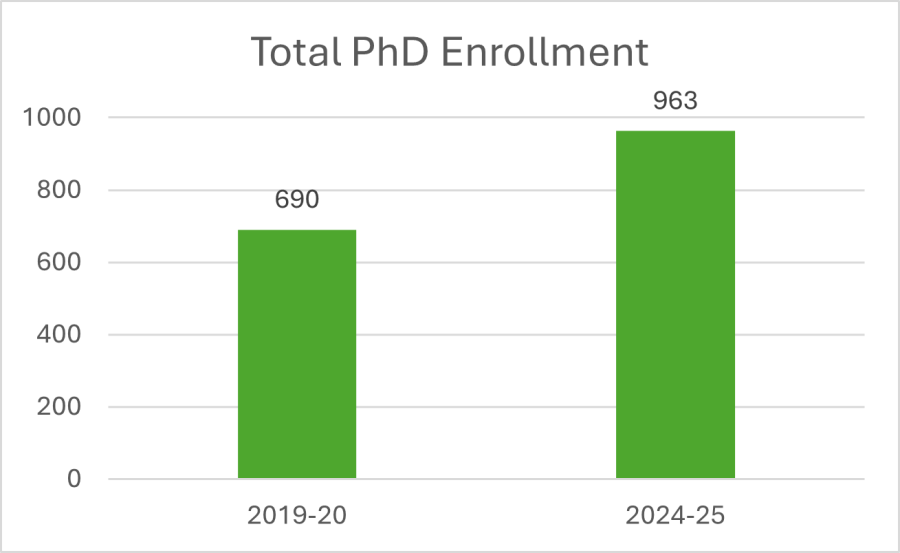
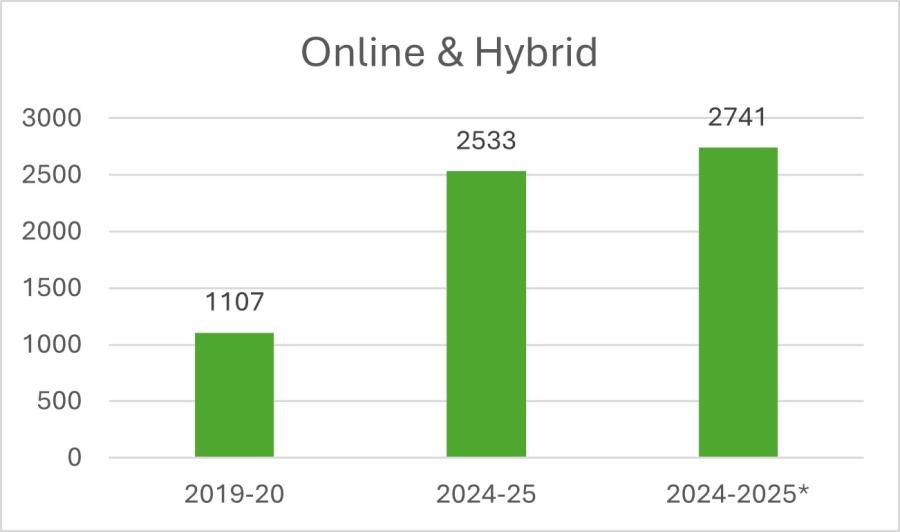
Behind these headlines lie numbers that tell the story of a rapid transformation in graduate education at Baylor. Some changes stemmed from our PhD goals. Some grew from our continued expansion in graduate professional education. For example, the College of Arts & Science has traditionally been the largest of Baylor’s thirteen colleges and schools, and remains so among undergraduates. But today, the largest graduate population is in the Robbins College of Health and Human Sciences. The fastest growth of graduate enrollment since 2019 is in the Herrington School of Nursing (an increase of 322%!). Robbins is home to many of our new hybrid professional programs, including Communication Sciences and Disorders (Speech Pathology), Physical Therapy, Occupational Therapy, and Medical Science. The Nursing School offers our single largest program, the Doctor of Nursing Practice.

Add to these other programs such as the online MBA and EdD (*and then the online programs in the Garland School of Social Work and the Law School) and we see the expansion of online and hybrid programs that both reveal and amplify Baylor’s national reach and reputation.
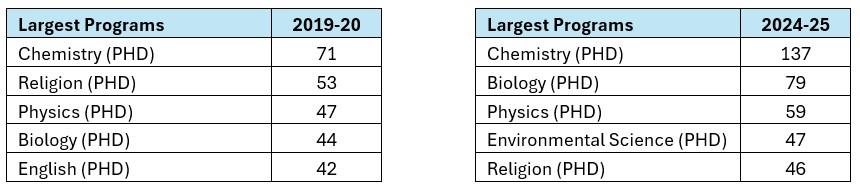
Turning back to our PhD programs, the plan developed in 2019 sought to accelerate growth in Baylor’s STEM programs. Our historically strong humanities programs, which were already producing scholarship and graduates at an R1-level, had little desire to add pressure to a difficult academic job market. As a result, Baylor’s PhD student body shifted from one most commonly found in seminars, libraries, and archives to one more often found in labs or the field. Today, STEM students make up four of our five largest programs (as well as the next six largest). Religion remains the only non-STEM program in the top ten.
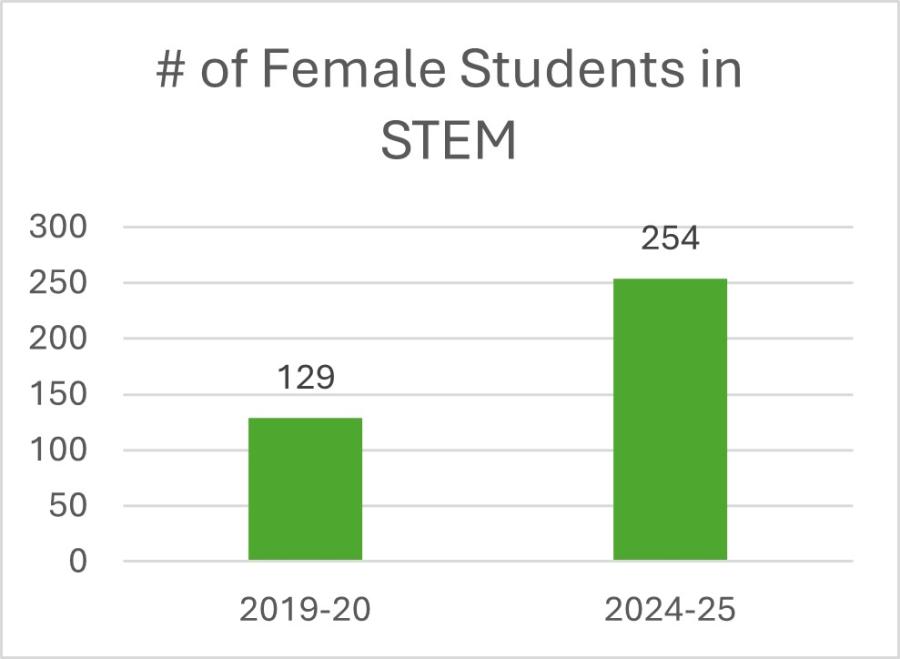
Demographic changes within the programs are equally dramatic. Women now make up nearly fifty percent of total PhD students. This increase is particularly noticeable in our STEM programs, where female students grew to 47% of the total student body.

Minority enrollment has also increased. Nationally, research universities compete for top students from underrepresented backgrounds, making them among the most sought-after recruits. Baylor has historically struggled in this area, but meaningful progress is being made. Since 2019, our Hispanic population has nearly doubled (98%) and our Black and African American population grew by a staggering 385%. Such growth over low starting numbers can be overstated, but underrepresented minority students now make up nearly a quarter of all students.
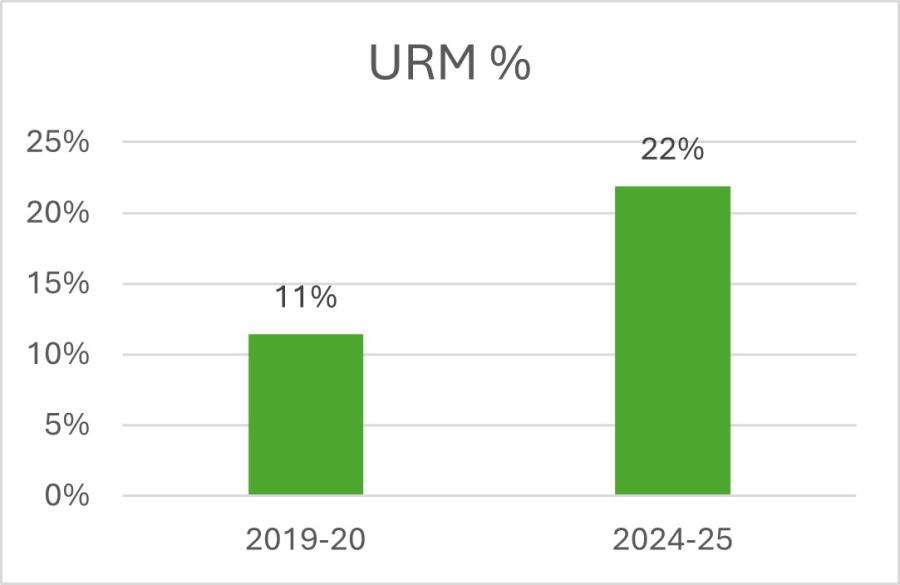
Thus over the past five years Baylor’s PhD programs have become larger and more diverse. This increase in female and underrepresented minority enrollment enriches the student experience and broadens the perspectives of our graduates. It also means that our student body more closely resembles the population we seek to serve. But a final measure is most important.
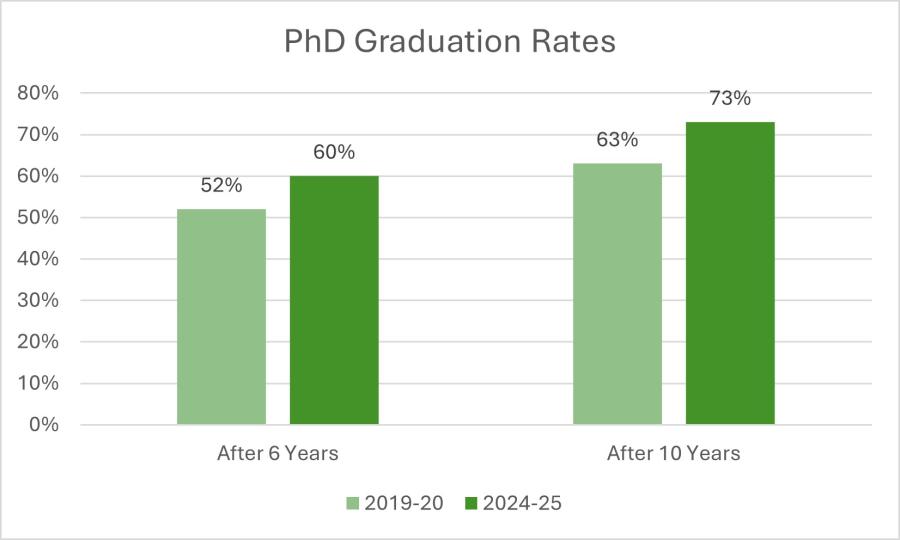
In 2019 our graduation rates were marginally better that the national average of 55%. After six years at Baylor only 52% of students had graduated, after ten years 63%. Today’s rates have risen to 60% and 70%, respectively. So along with our enrollment goals, we challenged our faculty to achieve an 80% graduation rate. Today, though work remains, we have made meaningful progress.
In sum, the past year serves as a fitting capstone to Dean Lyon’s tenure as Dean of the Graduate School. Graduate students now represent a quarter of Baylor’s overall enrollment. The sustained growth in our online and hybrid programs continues to enhance and diversify our graduate student body. The success of the 2019 strategic plan and increase in PhD graduation rates produced our largest number of PhD graduates. And continued growth in the years to come is certain. As we say farewell over the coming months, we do so with tremendous gratitude and appreciation for all he has done to make Baylor a Christian research university worthy of the name.
< Previous Next: New Research Resources for Graduate Students >