

Bill Hockaday
Associate Dean for Research

At a ceremony and banquet in McLane Stadium, overlooking downtown Waco on a beautiful Fall afternoon, we celebrated fourteen PhD students and their faculty mentors for receiving the Baylor Graduate School awards for Outstanding Instruction, Research, and Dissertation. Many inspiring words were shared by students and faculty that left us with a sense of pride in Baylor’s graduate programs. Particularly memorable were the words of outstanding student instructor (currently a Baylor Postdoc Teaching Fellow), Kristyn Drew Woytkewicz, who said, “What makes Baylor University a great place to study is the intentional pursuit of excellence in community.” As a former graduate student, and now a professor and mentor to graduate students, I agree. What distinguishes Baylor is its culture of shared purpose. A large and growing body of data demonstrates the importance of community to graduate student success and satisfaction. A survey of 3,785 PhD candidates from around the globe, The Global PhD Landscape, enumerates multiple predictors of student morale, satisfaction and resilience, but they all come down to this—excellence in community.
A Community of Scholarship
The most significant predictors of graduate student satisfaction are faculty mentoring and opportunities to engage in the intellectual community through professional meetings and original publications (Nordling 2025a). During calendar year 2024, Baylor Graduate School provided financial support for 340 graduate student conference presentations. Also during 2024, Baylor-affiliated authors published more than 2,270 articles, papers, books, and book chapters (indexed in the Scopus database). Approximately half of these publications, 1,125, were authored or co-authored by Baylor graduate students. As one measure of their impact, these publications have received more than 13,230 citations in the first year.
A Diverse Academic Community (Pro Mundo)
International students are increasingly important to Baylor graduate programs, contributing to the intellectual community through their research and teaching. In the Fall 2025 semester, international students account for 25% of graduate student instructors of record, serving 39 lecture courses, 212 laboratory courses, and 17 exercise courses. More difficult to quantify, but no less important is diversity of ideas, experiences, perspectives and expertise that international students bring to our undergraduate classrooms and labs.
The growth of a diverse international graduate student body is attributable to many factors, not the least of which are reputation and affordability (Nordling 2025b). In supporting international students the Graduate School has a long-running partnership with Center for Global Engagement (CGE) to offer affordable housing, transportation, and meal plans. English language support continues to be a priority as well. The graduate school and CGE continue to offer a formal course for international students serving as first-time teaching assistants in GBL 5201. Two new graduate courses were added this year, English for Academic Purposes: Writing (GBL 5331) and Speaking (GBL 5333).
Excellence in Research: Student Awards
Competing for national research awards requires significant teamwork between students and faculty. Therefore, awards acknowledge excellence in the student’s scholarship and in the intellectual community around them. Despite the uncertainties in federal research agency funding, Baylor graduate students have cause to remain steadfast in their pursuit of external grants, fellowships, scholarships and awards. We are more competitive than ever. Three (3) Baylor PhD students currently hold the highest award given to graduate students by National Science Foundation—the Graduate Research Fellowship. In the 2025 NSF competition, seven (7) Baylor students were named runners-up, receiving honorable mention. The prestigious Boren Fellowship of the Department of Defense was awarded to Rebeca Blemur, a History PhD student conducting research in Senegal. Anthropology PhD student, Marcela Pfaff Nash, won the 2025 Graduate Women in Science National Fellowship. Congratulations to all graduate student award winners and their faculty mentors. If an award is not mentioned here, please reach out to the graduate school deans.
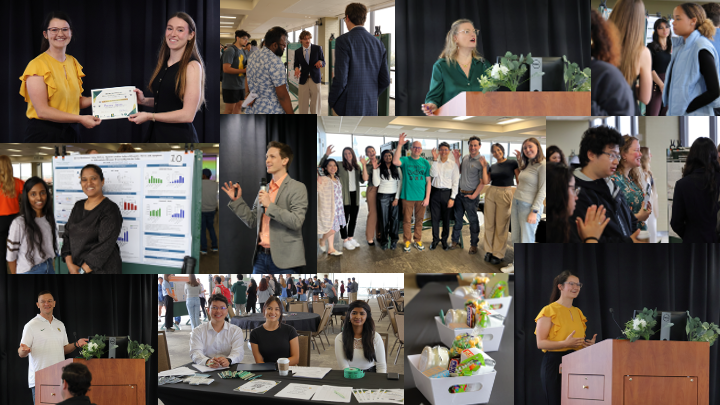
The competitiveness of Baylor students for major national awards begins locally, growing from excellence in the community of scholars on campus. An exemplar of Baylor graduate student research community is the BEAR symposium—created, organized, and hosted by Baylor’s Biology graduate student society, Cellular-Molecular and Ecological Graduate Student Society (CEGSS). The symposium is a scientific conference for Baylor graduate students and faculty researchers with the stated aim of developing and improving personal and professional relationships across Baylor University’s diverse STEM fields. The 2025 Symposium had 64 presenters and 100+ attendees.
References
Nordling, L. 2025a. Are these the happiest PhD students in the world? Nature 646:1013-1016.
Nordling, L. 2025b. On the move: why PhD students study abroad in 2025. Nature 647:809-811.