

Michael E. Young
Vice Provost and Dean
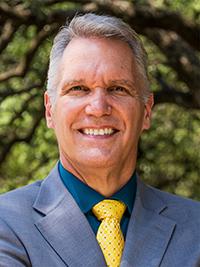
Greetings from the Graduate School! I joined Baylor University as the new Dean and Vice Provost on August 1, 2025. Dean Larry Lyon served in this role for 27 years and led Baylor University through a period of rapid growth in its graduate programs, rising from ~1,700 students in 1998 to ~5,800 students by 2025. I arrived with the opportunity to guide the School in its next phase of development. The first major change occurred in July.
Immediately before I arrived last summer, the Graduate School’s staff grew by 50% when the Graduate Professional Education (GPE) unit, led by Vice Provost Gary Carini, was moved into the Graduate School. GPE was designed to accelerate the development and delivery of online graduate professional programs. Its efforts were extremely successful – online students now represent 46% of the 4,993 students managed by the Graduate School (this does not include most of Truett Seminary, Garland School of Social Work, or the Law School). The ongoing support of these programs in addition to the creation of new programs continues under the Graduate School umbrella.
With the arrival of any new Dean comes new aspirations as well as renewed focus on some existing goals. One of those existing goals receiving renewed attention is the desire to maximize the success of our students’ progress toward their degrees, both in terms of their graduation rate and their time-to-degree.
As a consequence of the increased operational complexity due to the addition of graduate professional and online programs to our portfolio, the Graduate School has a renewed emphasis on operational excellence. We are creating clear and open communication channels both within the School as well as between us and other units on campus with which we are having more contact. Changes on our radar include restructuring the Graduate Council and revisiting our policy documents.
Successfully Completing the Degree in a Timely Manner
Receiving a graduate education entails an opportunity cost - with 72% of our graduate students enrolled full-time, these students are foregoing the salary that they could be earning in the work force. Thus, educators must optimize each student's time at Baylor by helping them to attain their educational goals in a timely manner.
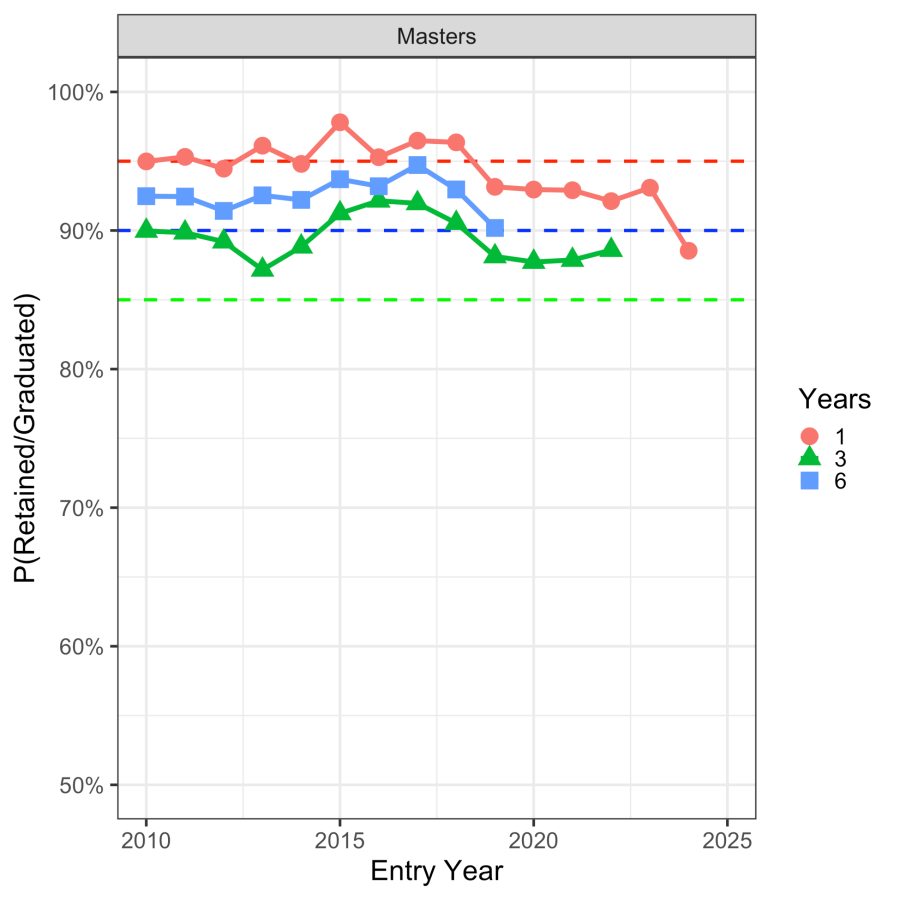
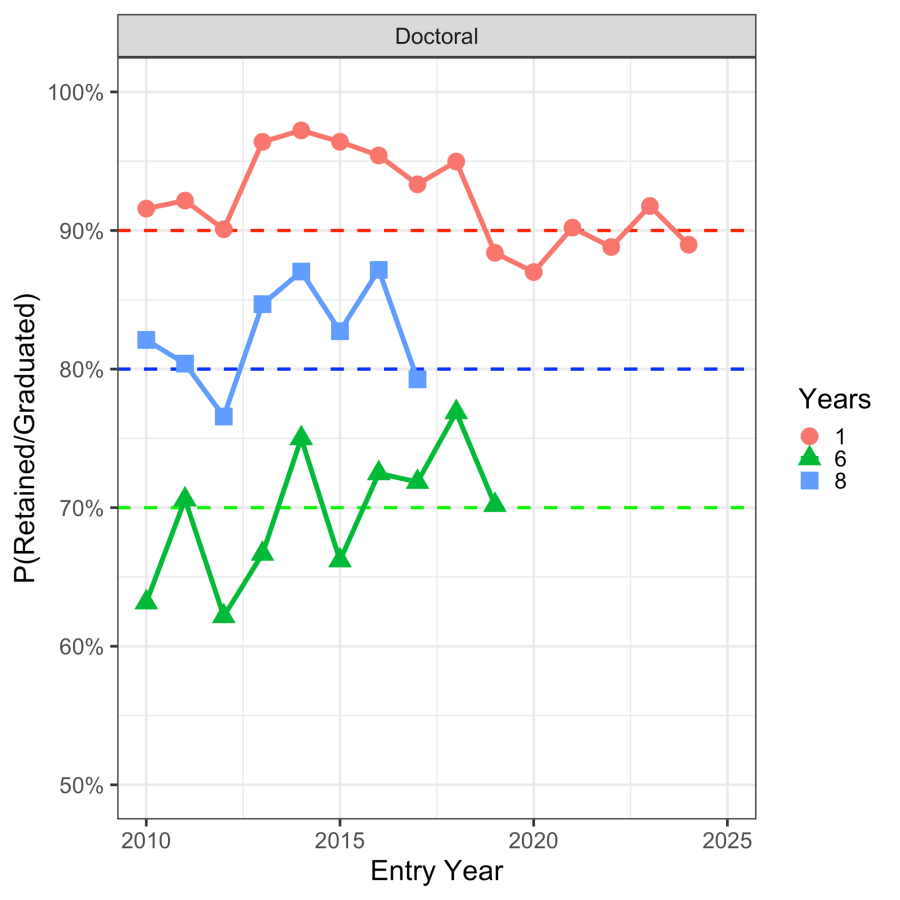
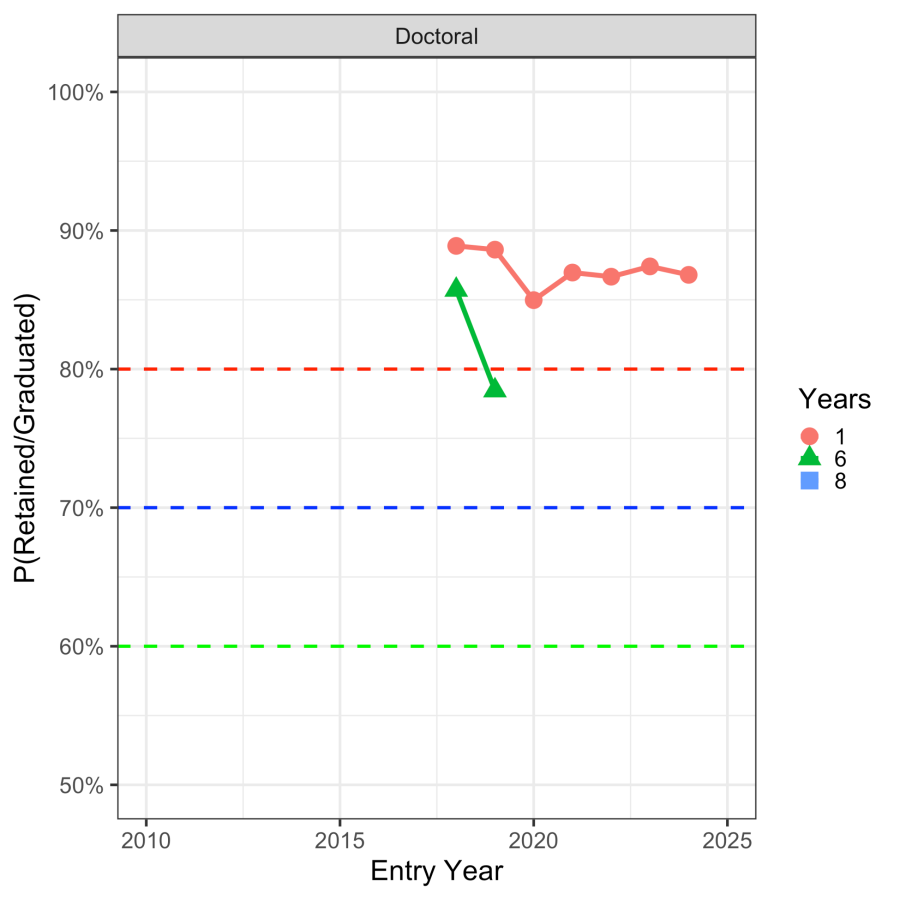
Our 2030 goal is to consistently graduate students without unnecessary delay while retaining program quality. We established targets for the percentage of students graduating within certain time frames. The targets are noted in each of the four graphs below. To ensure such strong graduation rates, first-year retention must be very high because it provides a ceiling on future graduation rates. Thus, our graphs also include the first-year retention rate (the top line) as a harbinger of the achievable graduation rate for each cohort.
The first two graphs below plot changes in our first-year retention and various graduation rates of primarily residential student cohorts who entered within the last 15 years (note that we cannot compute graduation rates for time periods that have not elapsed for a cohort). Residential Masters 3-year graduation rates have been slowly trending downward over the years but have stayed above the 85% goal. The impact of the 2020 COVID pandemic was first revealed in the lower first-year retention rates for the 2019 cohort. The 2024 retention data again dipped and will eventually result in lower graduation rates than desired; we will be closely monitoring those retention data to address any causal factors.
For the largely residential research doctoral programs, graduation rates have been moving up, and our most recent qualifying cohorts have reached our desired graduation rates although the impact of COVID for the 2019 and following cohorts is only now being revealed.
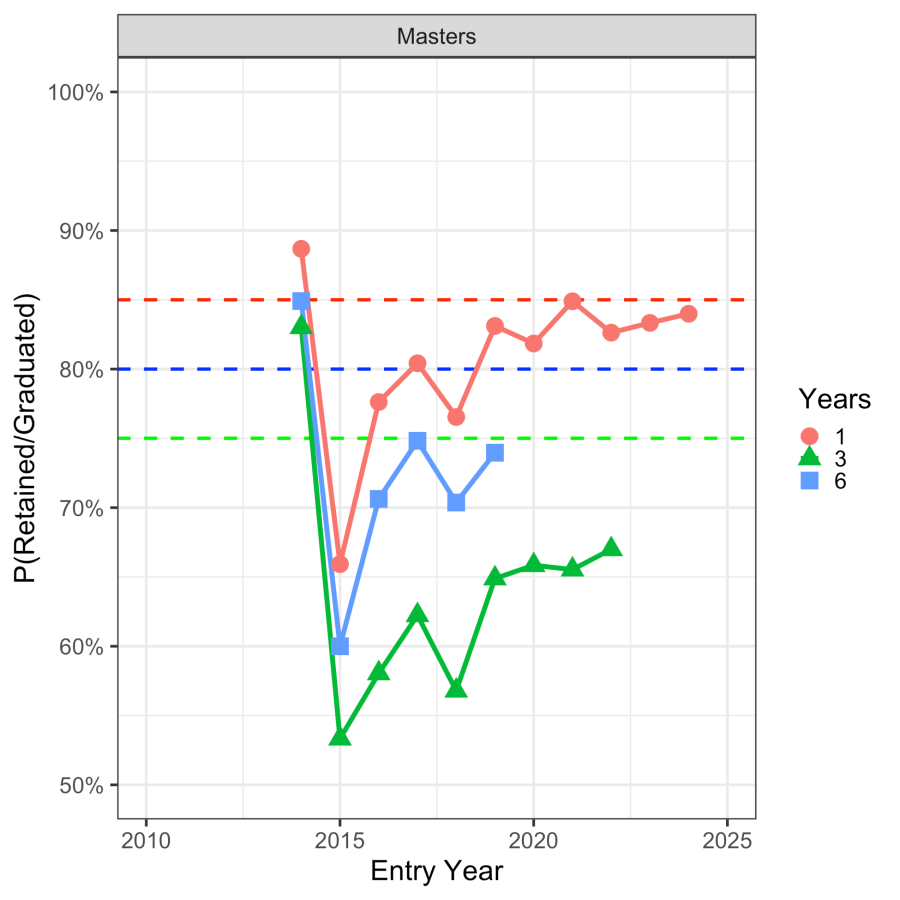
The last two graphs plot changes in our graduation rates for the online and professional student cohorts who entered within the last 15 years (note that none of these programs existed before 2013). The first such program launched in 2014 (the online MBA) with a cohort of 32 students and then more than doubled in size for the 2015 cohort. The number of programs slowly grew until 2019 when the number of programs and enrolled students increased dramatically due to the launch of Baylor’s Graduate Professional Education unit.
For the online and professional programs, the professional doctoral programs (the OPT, DPT, and DNP) were separated from our research doctoral programs because these professional programs are low residence, on an accelerated time schedule, and relatively new additions to the Baylor portfolio. The following graphs reveal the shorter history of these programs.
Because national trends indicate that online and low residency programs have lower retention and graduation rates, our targets were adjusted downward but only by 10% - Baylor aspires to be among the best. The typical online program at a non-profit institution has 10-30% lower completion rates than the typical residential program. Our 2030 goal is to reach the aggressive targets shown below. First-year retention targets are likewise adjusted downward to acknowledge the professional and life demands of online students.
Online graduate programs have grown dramatically at Baylor, and this trend is common across the higher education sector. We are moving in a good direction for our Masters programs and are starting at a good place for the doctoral programs.
International Graduate Students
International (non-resident) graduate student enrollment has more than doubled over the past 10 years, from 225 in Fall 2016 to 538 in Fall 2025. The greatest rates of growth have been in the College of Arts and Sciences (134 to 244), Robbins College (8 to 35), the School of Education (5 to 37), and the School of Engineering and Computer Science (38 to 76). Despite the substantial growth, international students still only comprise 9% of Baylor’s graduate student body. This proportion is well under the 29% for institutions classified as Doctoral-Research or R1.
To meet the Pro Mundo (For the World) pillar of our strategic plan, Baylor In Deeds, the university emphasizes expanding the university’s global influence. Thus, the Graduate School needs to be prepared for continued increases in international student enrollment. This preparation includes expanding our faculty mentor training, strong support of Baylor’s Center for Writing Excellence and its Division of Graduate Writing, strengthening our relationship with Baylor’s Center for Global Engagement, and facilitating our graduate students’ understanding of Baylor’s Christian mission with a global outreach.
The Future!
Nationally, there are a number of new challenges facing graduate education. These challenges include the impact of student loan caps, proposed changes to the indirect cost structure of grants that are instrumental to funding graduate research assistants, and the consequences of changes to the H1-B Visa on international student employment in areas of critical need. Given Baylor University’s excellent preparation of its graduate students and the strong case for graduate education as a driver of economic prosperity and innovation, Baylor University’s Graduate School is well-positioned to face these headwinds. We invite your prayers in support of our mission of serving our graduate students, the university, Texas, and the world!